
Backup and Restore
Lowest cost. Data is backed up regularly and restored after an incident, suited to non-critical systems.


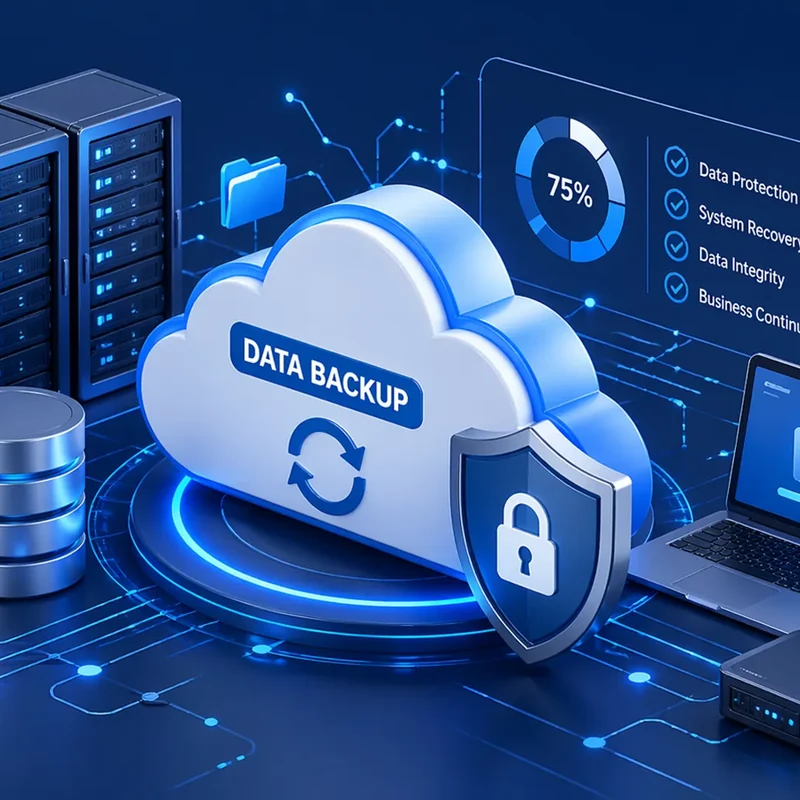
Hardware failures, ransomware, human error and outages can stop your business in hours. echoBitz designs automated cloud backups and disaster recovery plans that protect your data and bring your systems back within the recovery time you set.
Lowest cost. Data is backed up regularly and restored after an incident, suited to non-critical systems.
A minimal copy of your system runs in another region and scales up quickly when needed.
Critical systems run in two locations at once for near-zero downtime during failures.
From protecting everyday data to recovering from a major outage, we cover the full cycle.
Identify critical systems and set recovery time (RTO) and data-loss (RPO) targets for each.
Scheduled, encrypted and versioned backups of servers, databases and files.
Immutable and off-site backup copies that attackers cannot delete or encrypt.
Copy data and systems to another region to survive a regional failure.
A documented runbook that tells your team exactly what to do during an incident.
Regular restore tests and failover drills to prove your plan works.
Find critical data and risks.
Set recovery targets and strategy.
Configure backups and replication.
Run restores and failover drills.
Monitor and update the plan.
Your data survives failures, errors and attacks.
Back online within the time your business can accept.
Tested recovery, not just stored copies.
Retention and recovery evidence for audits.
Questions about backup and recovery? Here are the answers clients ask most before starting with echoBitz.
Talk to an ExpertBackup is a copy of your data. Disaster recovery is the complete plan and setup to restore your systems and operations after a major failure, using those backups and standby infrastructure.
RPO is how much data you can afford to lose, measured in time. RTO is how long you can afford to be offline. We set both for each system and design around them.
Yes, when they are immutable and stored off-site, so attackers cannot change or delete them. We configure this as part of the backup design.
It depends on how much data you can lose. Critical databases may need continuous or hourly backups, while less critical files may be backed up daily.
Yes. We run scheduled restore tests and failover drills and report the results, because an untested backup is not a reliable one.
We build backup and recovery on AWS, Microsoft Azure and Google Cloud, and can also protect on-premise servers by backing them up to the cloud.